The Organisation for Economic Co-operation and Development (OECD) has released a report analyzing the expanding use of artificial intelligence (AI) in public procurement. The report says governments and public entities worldwide are deploying AI across procurement workflows to achieve cost reductions, faster processing times, enhanced transparency, and broader vendor participation. This publication is part of the OECD's ongoing 'Governing with Artificial Intelligence' series, which aims to provide policy guidance for establishing AI governance frameworks in the public sector.
Scope of AI Applications in Public Procurement
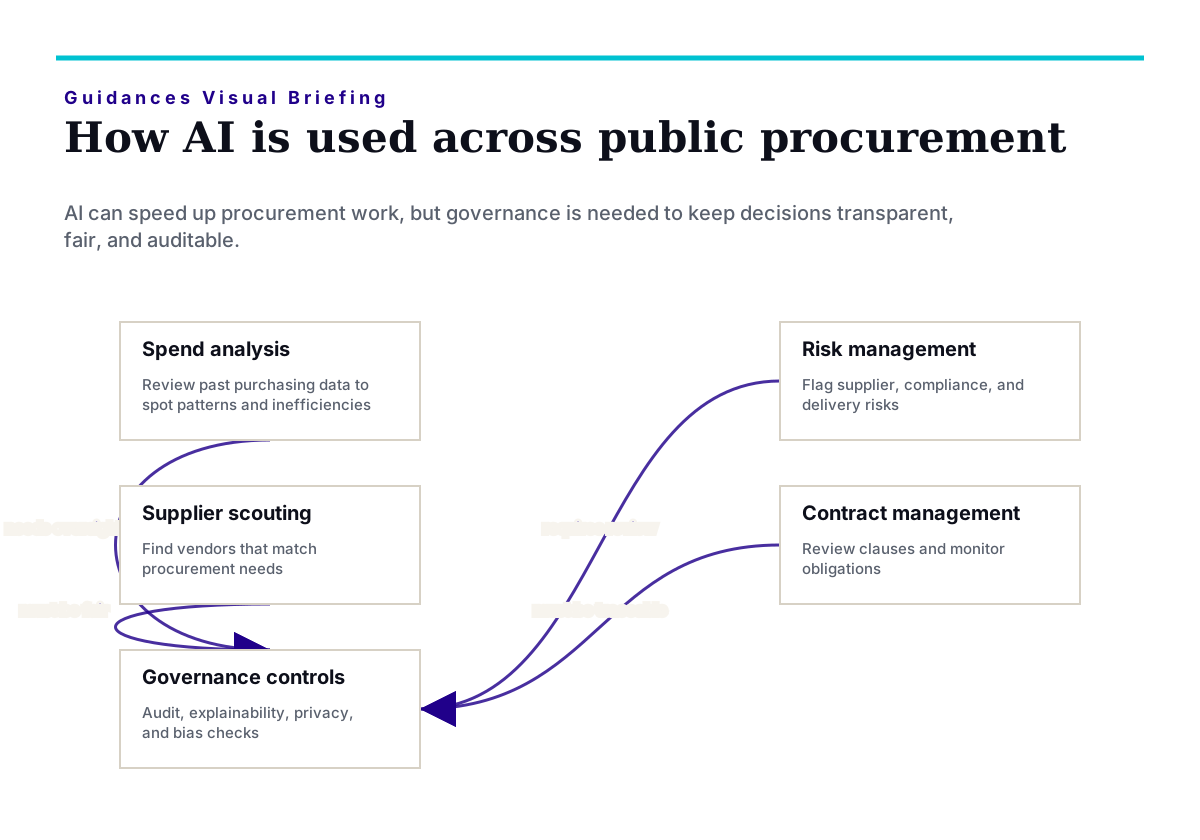
According to the OECD report, public agencies are applying AI at multiple stages of the procurement lifecycle. Key areas of deployment include spend analysis, risk management, supplier scouting, and contract management. In spend analysis, AI systems examine historical procurement data to optimize budget allocation, identify duplicate expenditures, and flag anomalous spending patterns. For risk management, AI tools assess supplier financial health, past contract performance, and regulatory compliance, enabling procurement officers to make faster, more informed decisions.
In supplier scouting, AI searches large databases to recommend potential vendors that match specific requirements, thereby expanding opportunities for small and medium-sized enterprises and new market entrants. During contract management, natural language processing (NLP) technologies are used to review contract clauses, detect delivery delays, and issue early warnings of potential issues. These AI tools reduce the administrative burden on procurement staff and improve the consistency and objectivity of decision-making.
Cost Reduction and Transparency Gains
The report highlights impacts of AI adoption on both cost structures and transparency in public procurement. Automated data analysis and process optimization are shortening procurement cycles and lowering administrative expenses in numerous documented cases. In large-scale procurement projects, AI rapidly evaluates thousands of bid proposals, automates price comparisons and quality assessments, and reduces manual workload for procurement teams.
On the transparency front, AI systems record each step of the procurement process and maintain traceable decision rationales, contributing to accountability. Some countries have implemented AI-powered procurement platforms that publish bid information and contract performance data in real time, allowing citizens and audit bodies to monitor activities. These developments are strengthening public trust in procurement systems and fostering competitive environments. Record-keeping and traceability play a critical role in maintaining procurement integrity, providing audit agencies with a foundation to verify procedural compliance.
Governance and Policy Challenges
Alongside the benefits, the OECD emphasizes the importance of establishing robust governance frameworks. As AI systems exert greater influence over procurement decisions, issues such as algorithmic bias, data quality, explainability, and accountability have emerged as key policy concerns. Because public procurement involves taxpayer funds, the report stresses the need for institutional safeguards to ensure AI system fairness and transparency.
The OECD recommends that governments embed ethical principles and legal requirements into AI procurement system design from the outset, and maintain system reliability through regular audits and performance evaluations. It also calls for expanded AI training programs for procurement officers and policymakers to build both technical competence and ethical judgment. Data security and privacy protection are highlighted as essential considerations, with AI systems handling supplier and contract information required to meet stringent security standards.
Algorithmic bias is particularly concerning in supplier selection and risk assessment. If historical data contains embedded biases, AI models may disadvantage vendors of certain sizes or regions. Preventing this requires ensuring training data representativeness and establishing procedures for regular review of model outputs. Explainability is also a critical requirement: procurement officers and stakeholders must be able to understand why an AI system recommended or excluded a particular supplier.
Need for International Cooperation and Standardization
The OECD underscores that effective use of AI in public procurement requires international cooperation and standardization. Divergent national standards and regulations can create confusion for companies operating in global supply chains and hinder AI system interoperability. The organization plans to continue facilitating the sharing of best practices among member countries and developing common principles and guidelines.
The report also notes that as AI technology evolves rapidly, policies and regulations must remain flexible. Rather than rigid rules, a principle-based approach is recommended to strike a balance between fostering innovation and protecting the public interest. Achieving this balance will require multi-stakeholder governance structures involving government, industry, academia, and civil society.
Standardization efforts must encompass not only technical aspects such as data formats, interface specifications, and performance metrics, but also institutional dimensions including ethical principles, responsibility allocation, and audit procedures. Once international standards are established, AI procurement solution developers can reduce the burden of meeting disparate national requirements for market entry, and governments can adopt verified solutions more rapidly.
Outlook and Technology Development Directions
AI adoption in public procurement is expected to continue expanding. Advances in generative AI and large language models (LLMs) are likely to extend AI's role into more complex tasks such as contract drafting, legal review, and supplier communication. For example, generative AI could automatically draft standard contract templates and adjust clauses to match specific procurement requirements. Multilingual capabilities may also lower language barriers in international procurement projects.
At the same time, technical and institutional efforts to ensure AI system reliability and fairness must proceed in parallel. Model validation techniques, bias detection tools, and explainability frameworks are continuously improving, and these technical advances will strengthen the trust foundation for public-sector AI adoption. As standardized metrics and benchmarks for evaluating AI system performance and impact are developed, governments will be able to apply more objective criteria when selecting solutions.
The OECD's report is expected to advance international dialogue on public-sector AI governance and provide guidance for governments seeking to deploy AI responsibly. Given that public procurement accounts for a substantial share of government spending, successful AI-driven innovation in this domain could significantly improve fiscal efficiency and public service quality. The digital transformation of procurement processes may go beyond mere technology adoption, serving as an opportunity to redefine how the public sector operates and relates to citizens.