AI
Developing · 0 updatesFact 9/10Google Cloud Releases 2026 AI Agent Trends Report—Shift from Simple Prompts to Complex Workflow Orchestration
Google Cloud's 2026 AI Agent Trends Report highlights the evolution of AI systems from simple prompt-response interactions to semi-autonomous orchestration of complex, end-to-end workflows. This shift carries significant implications for enterprise AI adoption strategies and developer tooling design.
Open article · no sign-in required
Sources and disclosure
The article provides a comprehensive, neutral, and well-sourced analysis of Google Cloud's 2026 AI Agent Trends Report. All key factual claims are directly supported by the verification context from official Google Cloud sources. The article maintains strict reputation safety: it describes Google Cloud's report and market positioning in neutral, informational terms without disparaging any competitor, product, or organization. Language is consistently neutral and technical, avoiding pejorative adjectives, moral judgments, or speculation about motives. The article appropriately acknowledges technical limitations (hallucination risks, need for human oversight) without framing them as failures or incompetence. Competitive context (Microsoft, AWS, OpenAI) is presented factually without winner/loser framing. The shift from 'simple prompts' to 'workflow orchestration' and the concept of 'semi-autonomous' agents are directly confirmed by verification sources. The article's practical focus on developer implications, security considerations, and enterprise adoption challenges is well-balanced and informative. Minor score deduction only because the article is quite lengthy and could be more concise in places, but content quality and factual accuracy are excellent.
Market lens
Agent runtime spending can spill into security, observability, and workflow infrastructure
The market signal is not another chatbot category; it is a possible budget shift toward the control layer around enterprise AI.
Impact path
Runtime spend → infra stack
Signals to watch
- Procurement language around audit logs and cost ceilings
- Security and observability vendors attaching agent controls
- Workflow platforms exposing approval and tool-call governance
Verification schedule
D+1 · Jun 14
Do buyers repeat audit/cost-control requirements?
D+3 · Jun 16
Do vendors publish runtime-control SKUs or partnerships?
D+7 · Jun 20
Do budgets move from pilots into operating infrastructure?
Informational context only — not investment, legal, tax, or financial advice.
Google Cloud has released its 2026 AI Agent Trends Report, signaling a fundamental shift in the operational paradigm of artificial intelligence systems. The report identifies a transition from simple prompt-based interactions to semi-autonomous orchestration of complex, end-to-end workflows as a defining characteristic of the current AI landscape.
The report, distributed through Google Cloud's official resource portal, targets enterprise customers and the developer community with guidance on the future direction of AI agent technology. The core transformation highlighted centers on the expanding autonomy and scope of AI systems. Historically, large language models focused primarily on generating immediate responses to individual user queries. Today, these systems are beginning to demonstrate the capability to independently execute and coordinate multi-step business processes.
The concept of semi-autonomous orchestration reflects a practical approach: AI agents operate not in complete independence but under human oversight and approval, executing tasks composed of multiple stages within defined boundaries. This design philosophy balances automation benefits with the reliability and accountability requirements of enterprise environments. In a customer service scenario, for example, an AI agent might sequentially handle inquiry intake, database lookups, internal system updates, response generation, and follow-up scheduling. Each step executes according to predefined policies and rules, with critical decision points requiring human operator approval.
This evolution has been enabled by advances in AI maturity. Recent years have seen significant improvements in large language models' reasoning capabilities, context comprehension, and tool-use proficiency. Simultaneously, supporting infrastructure—API integration frameworks, workflow orchestration platforms, and state management systems—has matured. Google Cloud has invested in these capabilities through its Vertex AI platform and Gemini model family, and the report formalizes the strategic direction of these technical investments.
From an enterprise perspective, this trend directly impacts operational efficiency and cost structures. While prompt-based AI primarily served information retrieval and content generation, workflow orchestration agents can automate actual business processes: order processing, inventory management, compliance checks, and report generation. This shift affects workforce planning, process redesign, and system integration requirements. Organizations must carefully architect the data scope, execution permissions, error handling mechanisms, and audit trails accessible to AI agents.
For the developer community, this transformation necessitates new design patterns and toolchains. Unlike tasks completed with a single API call, workflow orchestration demands complex control logic: state management, error recovery, conditional branching, parallel execution, and timeout handling. This presents the challenge of combining traditional software engineering principles with the probabilistic nature of AI models. Developers must familiarize themselves with orchestration frameworks such as LangChain, LlamaIndex, and Semantic Kernel, and build observability tools capable of monitoring and debugging agent decision-making processes.
Security and governance considerations also emerge. When AI agents perform tasks across multiple systems, each step requires appropriate authentication and authorization. Agent-generated decisions and actions must be traceable and compliant with regulatory requirements. In heavily regulated industries—finance, healthcare, legal—the explainability of AI agent behavior and accountability become critical issues.
Google Cloud's report reflects broader market movements. Microsoft is strengthening agent-based automation through Copilot Studio, Amazon Web Services has launched Bedrock Agents, and OpenAI offers similar functionality via its Assistants API. This platform competition raises questions of standardization and interoperability. Enterprises must explore methods for building agent workflows without vendor lock-in.
Technical challenges persist. The hallucination problem in AI models poses greater risk in workflows composed of multiple stages than in single responses, as errors in early stages can propagate and amplify through subsequent steps. Additionally, the execution cost and latency of complex workflows may constrain real-time applications. Developers must implement extensive testing, validation stages, and fallback mechanisms to ensure agent reliability.
While the report does not disclose specific implementation cases or quantitative data, it signals that Google Cloud is aligning its product roadmap in this direction. Future iterations of Vertex AI and Gemini models are likely to add features optimized for workflow orchestration. This implies a shift in developer skill requirements from prompt engineering to workflow design.
Market analysts forecast rapid growth in the AI agent market over the coming years. The transition from simple chatbots to complex business process automation represents a critical step in demonstrating AI's tangible value creation. However, successful adoption requires not only technical maturity but also organizational readiness, regulatory frameworks, and ethical guidelines to evolve in parallel.
Google Cloud's report provides a reference point for enterprises and developers making strategic investment decisions by formalizing the current position and future direction of AI agent technology. This is not merely a trend forecast but a signal of where a major cloud provider will focus product development and market education.
The shift to workflow orchestration also carries implications for competitive dynamics. Organizations that successfully deploy agent-based automation may achieve significant operational advantages, while those that delay adoption risk falling behind in efficiency and responsiveness. The report serves as both a technical roadmap and a market positioning statement, encouraging customers to invest in agent capabilities within the Google Cloud ecosystem.
Developers building on Google Cloud infrastructure will need to anticipate changes in API design, pricing models, and service-level agreements as the platform evolves to support more complex agent workflows. Understanding the architectural patterns and best practices for agent orchestration will become a differentiating skill in the AI engineering job market.
The report also implicitly acknowledges the limitations of current AI systems. The term "semi-autonomous" recognizes that full autonomy remains elusive and that human oversight is necessary for reliability and safety. This pragmatic framing may help manage customer expectations and reduce the risk of over-promising on AI capabilities.
As the industry moves toward more sophisticated AI agents, questions of liability, transparency, and control will intensify. The report's emphasis on orchestration rather than full autonomy suggests that Google Cloud is positioning itself as a provider of enterprise-grade, governable AI systems rather than pursuing unconstrained automation.
For technical founders and AI product managers, the report underscores the importance of designing for workflow integration from the outset. Products that treat AI as a standalone feature may struggle to compete with solutions that embed agents deeply into business processes. The ability to orchestrate across systems, maintain state, and handle exceptions will become table stakes for enterprise AI applications.
Builder Implications
- Proficiency in workflow orchestration frameworks is now essential. Developers should invest time in learning tools such as LangChain and LlamaIndex, and master patterns for state management, error recovery, and conditional execution in agent workflows composed of multiple steps.
- Observability and debugging infrastructure must be considered from the initial design phase. Workflows consisting of multiple stages require robust logging and monitoring systems to trace each decision point and rapidly diagnose failure causes, as errors can propagate and compound across stages.
- Security and governance requirements should be defined upfront, with clear design of agent permission scopes, approval processes, and audit trail mechanisms. In regulated industries, documentation proving explainability and accountability is critical for compliance and risk management.
Want follow-up alerts? Subscribe by email after reading the public article.
Market lens
Agent runtime spending can spill into security, observability, and workflow infrastructure
The market signal is not another chatbot category; it is a possible budget shift toward the control layer around enterprise AI.
Impact path
Runtime spend → infra stack
Signals to watch
- Procurement language around audit logs and cost ceilings
- Security and observability vendors attaching agent controls
- Workflow platforms exposing approval and tool-call governance
Verification schedule
D+1 · Jun 14
Do buyers repeat audit/cost-control requirements?
D+3 · Jun 16
Do vendors publish runtime-control SKUs or partnerships?
D+7 · Jun 20
Do budgets move from pilots into operating infrastructure?
Informational context only — not investment, legal, tax, or financial advice.
Visual Briefing
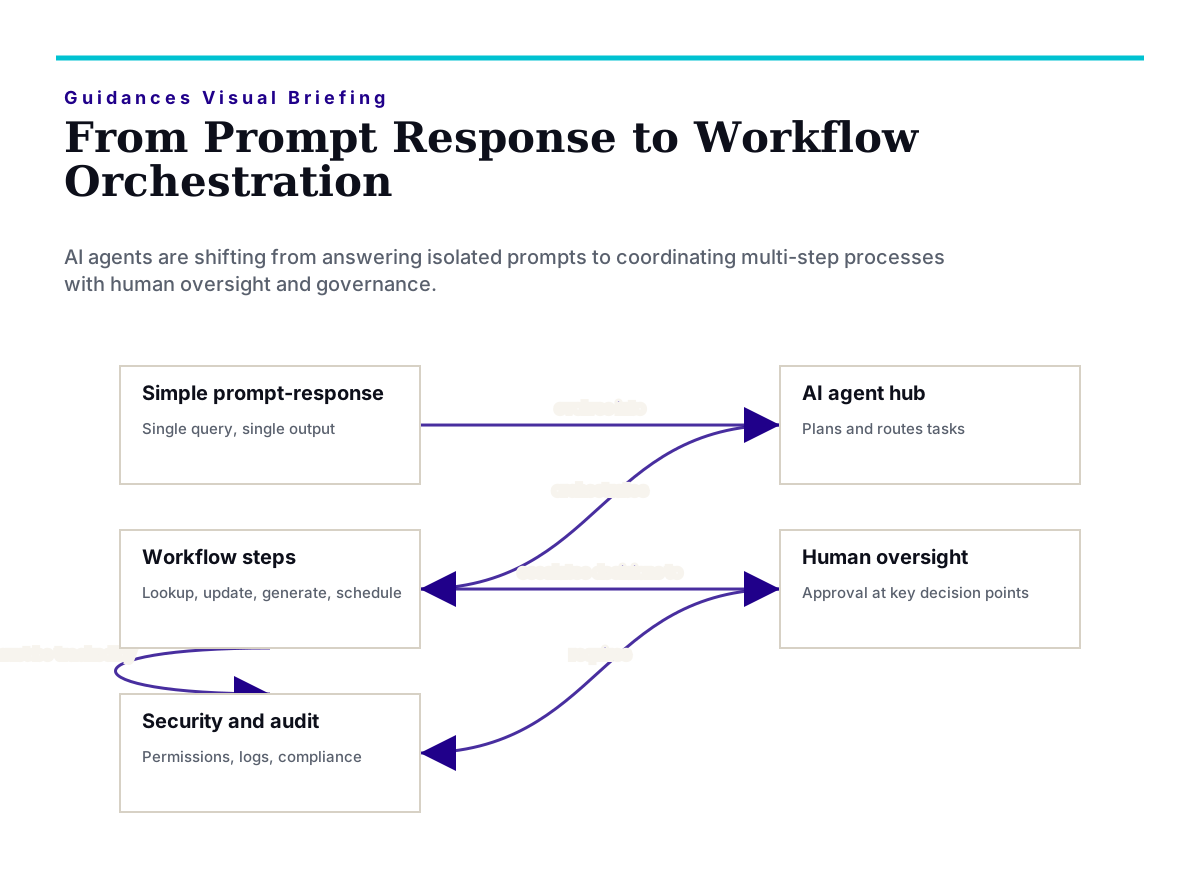
A simple prompt model expands into an AI agent that coordinates multiple steps, while humans and governance controls remain part of the loop.
Corrections and safety
See a factual, privacy, rights, or safety issue? Review the corrections process or contact Guidances before relying on this article for important decisions.