AI
Developing · 0 updatesFact 9/10Microsoft Outlines Enterprise-Wide AI Agent Deployment Strategy Emphasizing Phased Rollout and Governance
Microsoft has published a methodology for deploying enterprise-wide AI agents through its Copilot Studio blog. The guidance outlines key steps including purpose-driven planning, securing knowledge sources, ensuring compliance and responsible AI principles, piloting with target users, and scaling adoption, while recommending separate development, test, and production environments and an initial user cohort of approximately 100 participants.
Open article · no sign-in required
Sources and disclosure
The article is a factual, neutral report on Microsoft's published AI agent deployment methodology. All key claims are directly supported by the primary source (Microsoft Copilot Studio blog). The article describes observable guidance, procedural steps, technical recommendations, and operational considerations without disparagement, allegations, or reputation-damaging language. The five-stage methodology (planning with purpose, securing knowledge sources, ensuring security compliance and responsible AI, piloting with target users, scaling adoption), environment separation recommendations, and ~100-user pilot cohort size are all accurately represented and verifiable. The article appropriately acknowledges limitations and unknowns in the 'Uncertainty and Constraints' section. No disparaging, accusatory, or speculative language about intent is present. The content is informational and technical in nature, focusing on observable methodology rather than making character judgments. The article maintains appropriate neutrality and clearly distinguishes between verified facts and areas of uncertainty. Minor score deduction only because some operational details (timelines, specific success metrics) are not fully detailed in the source, but the article appropriately notes these limitations.
Market lens
Agent runtime spending can spill into security, observability, and workflow infrastructure
The market signal is not another chatbot category; it is a possible budget shift toward the control layer around enterprise AI.
Impact path
Runtime spend → infra stack
Signals to watch
- Procurement language around audit logs and cost ceilings
- Security and observability vendors attaching agent controls
- Workflow platforms exposing approval and tool-call governance
Verification schedule
D+1 · Jun 14
Do buyers repeat audit/cost-control requirements?
D+3 · Jun 16
Do vendors publish runtime-control SKUs or partnerships?
D+7 · Jun 20
Do budgets move from pilots into operating infrastructure?
Informational context only — not investment, legal, tax, or financial advice.
Microsoft has released practical guidance on deploying enterprise-wide AI agents, presenting a structured approach for large organizations to adopt generative AI tools safely and effectively. The guidance, published through the Microsoft Copilot Studio blog, draws on the company's experience deploying AI agents within its own organization as a customer zero.
Core Deployment Methodology
Microsoft divides enterprise AI agent deployment into five primary stages. First, the planning with purpose stage requires organizations to clearly define specific business objectives and use cases that AI agents will address. This approach focuses on tangible operational improvements rather than technology adoption for its own sake.
Second, the securing knowledge sources stage establishes security frameworks for the data and documents that AI agents access. Because generative AI systems leverage extensive internal knowledge bases, data access permissions, encryption, and sensitive information handling protocols must be established in advance.
Third, the ensuring security compliance and responsible AI stage concentrates on meeting regulatory requirements and ethical AI operating standards. This encompasses data privacy regulations, industry-specific compliance standards, and measures for bias mitigation and transparency.
Fourth, the piloting with target users stage involves testing AI agents in actual work environments with a limited user group. Microsoft recommends starting with an initial cohort of approximately 100 users, enabling organizations to collect real-world feedback and refine systems.
Fifth, the scaling adoption stage progressively extends AI agents across the organization based on pilot results. This phase emphasizes user training, support infrastructure development, and continuous performance monitoring.
Environment Separation and Initial User Scale
Microsoft emphasizes clear separation of development, test, and production environments. While environment separation is standard practice in software development, it holds particular importance for AI agent deployment. Development environments enable experimentation with new capabilities and prompt engineering, test environments facilitate security and performance validation, and production environments support actual operational work.
The recommendation for an initial pilot group of approximately 100 users represents a practical balance point. This scale is sufficient to capture diverse usage patterns and feedback while limiting the impact radius if issues arise. Additionally, a 100-person cohort can represent multiple departments and roles within an organization.
Operational Implications for Enterprise AI Deployment
This guidance reflects lessons Microsoft learned by deploying AI agents internally as customer zero. This approach, where technology vendors use their own products first to accumulate practical experience, provides direct insights for product improvement and customer support.
Enterprise-wide AI agent deployment extends beyond simple technology adoption to encompass organizational work processes, data governance, and workforce capability development as a transformational project. Microsoft's methodology acknowledges this complexity and presents a path to realize value while managing risk through a phased, controlled approach.
The emphasis on knowledge source security and compliance reflects the inherent risk factors of generative AI. Because AI agents can access internal documents, emails, and databases extensively, the potential for data leakage, unauthorized access, and regulatory violations is higher than with traditional software. Therefore, designing security architecture and access controls from the outset of deployment is essential.
Adherence to responsible AI principles addresses organizational ethical responsibilities beyond technical requirements. This includes the accuracy of content generated by AI systems, potential bias, and transparency toward users. Particularly when AI agents are used in customer-facing work or decision support, compliance with these principles directly affects organizational reputation and legal liability.
The customer zero approach provides Microsoft with firsthand operational data on deployment challenges, user adoption patterns, and integration friction points. This internal testing methodology allows the company to identify issues before customers encounter them and to develop more robust implementation guidance. For enterprise AI builders, this signals the value of internal piloting as a risk mitigation strategy.
The staged rollout model addresses the reality that enterprise AI deployment is not a one-time installation but an iterative process requiring continuous refinement. By starting with a focused user group, organizations can validate assumptions about workflow integration, identify training gaps, and adjust system configurations before broader rollout. This reduces the risk of large-scale disruption and allows for course correction based on empirical evidence.
The guidance also implicitly acknowledges the organizational change management dimension of AI adoption. Technical deployment is only one component; user acceptance, process redesign, and cultural adaptation are equally critical. The phased approach provides time for these softer elements to mature alongside technical implementation.
Uncertainty and Constraints
The published information outlines the deployment methodology but provides limited detail on specific execution methods, timelines, and success metrics for each stage. Additionally, concrete guidance on how deployment strategies should be adjusted by industry, organization size, and regulatory environment is not specified.
The recommendation for an initial user group of approximately 100 is a general guideline and may require adjustment based on organizational scale and complexity. For smaller organizations, this figure may be excessive, while for large global enterprises, operating multiple pilot groups by region or business unit may be more appropriate.
The generalizability of Microsoft's internal deployment experience to other organizations is also a factor to consider. As a technology company, Microsoft possesses a high level of technical capability and infrastructure, representing a different starting point than organizations in other industries.
The guidance does not address specific technical architectures, integration patterns with existing enterprise systems, or detailed security configurations. Organizations will need to translate these high-level principles into concrete technical implementations tailored to their specific technology stacks and operational contexts.
The timeline for each deployment phase and the criteria for progressing from pilot to full-scale adoption are not explicitly defined. Organizations will need to establish their own metrics for pilot success and thresholds for broader rollout based on their risk tolerance and operational requirements.
Builder Implications
- When deploying enterprise-wide AI agents, adopt a phased approach by clearly separating development, test, and production environments, starting with a pilot targeting approximately 100 users to collect real-world feedback before gradually scaling adoption across the organization.
- Design knowledge source security and data access controls from the beginning of deployment, and integrate industry-specific compliance requirements and responsible AI principles into both technical architecture and operational processes.
- Establish purpose-driven planning by defining specific business objectives and measurable performance indicators, and build user training and support infrastructure to increase adoption rates and effectiveness across the organization.
Want follow-up alerts? Subscribe by email after reading the public article.
Market lens
Agent runtime spending can spill into security, observability, and workflow infrastructure
The market signal is not another chatbot category; it is a possible budget shift toward the control layer around enterprise AI.
Impact path
Runtime spend → infra stack
Signals to watch
- Procurement language around audit logs and cost ceilings
- Security and observability vendors attaching agent controls
- Workflow platforms exposing approval and tool-call governance
Verification schedule
D+1 · Jun 14
Do buyers repeat audit/cost-control requirements?
D+3 · Jun 16
Do vendors publish runtime-control SKUs or partnerships?
D+7 · Jun 20
Do budgets move from pilots into operating infrastructure?
Informational context only — not investment, legal, tax, or financial advice.
Visual Briefing
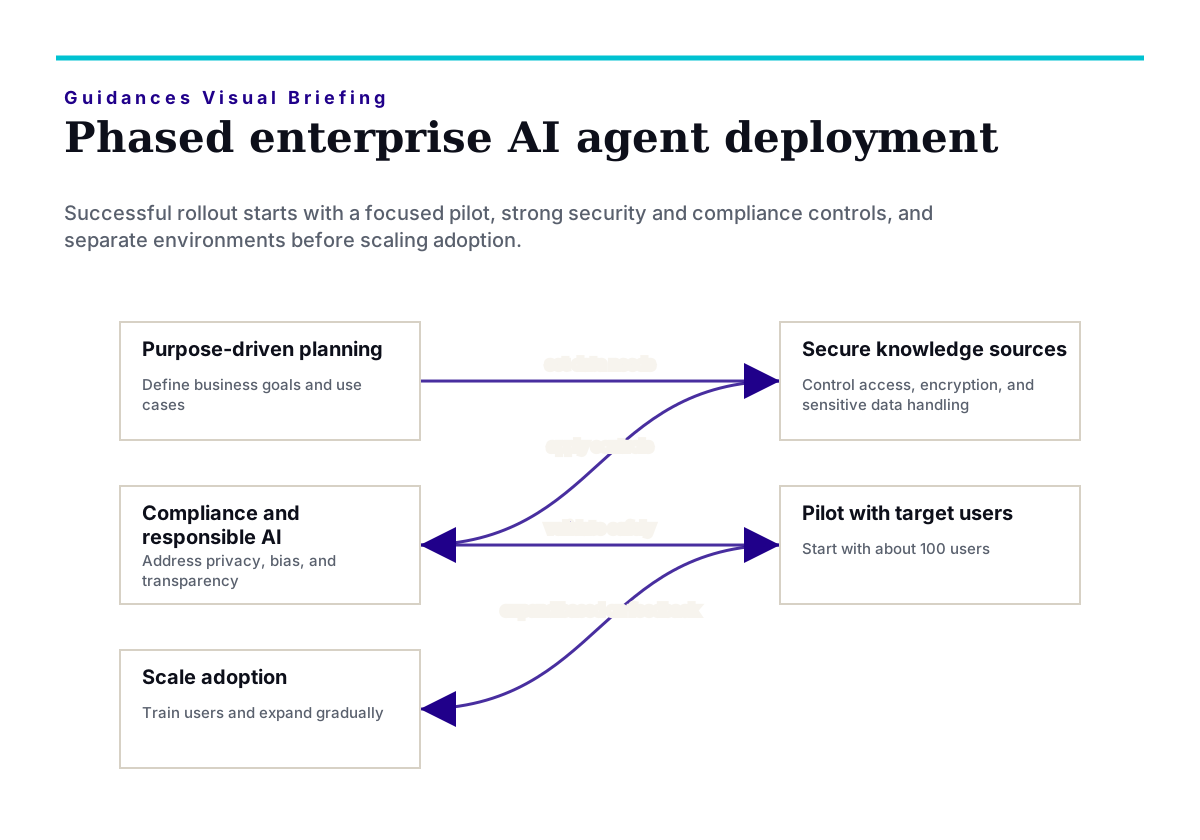
A staged deployment model moves from planning and security to pilot testing and then broader adoption.
Corrections and safety
See a factual, privacy, rights, or safety issue? Review the corrections process or contact Guidances before relying on this article for important decisions.