AI
Developing · 0 updatesFact 9/10AI Agent Autonomy Study Shows Computer-Control Sessions 47× Longer Than Search
An arXiv paper analyzing production data from Perplexity's search and computer-control agents reports that computer-control sessions averaged 26 minutes of autonomous operation versus 33 seconds for search, while matched task completion time dropped from 269 to 36 minutes.
Open article · no sign-in required
Sources and disclosure
The article accurately summarizes the findings of the arXiv paper, including specific numerical data on autonomous operation time and task completion time for Perplexity's search and computer-control agents. All calculations and comparisons are consistent with the provided source material. The article maintains a neutral and informative tone.
Market lens
Agent runtime spending can spill into security, observability, and workflow infrastructure
The market signal is not another chatbot category; it is a possible budget shift toward the control layer around enterprise AI.
Impact path
Runtime spend → infra stack
Signals to watch
- Procurement language around audit logs and cost ceilings
- Security and observability vendors attaching agent controls
- Workflow platforms exposing approval and tool-call governance
Verification schedule
D+1 · Jun 15
Do buyers repeat audit/cost-control requirements?
D+3 · Jun 17
Do vendors publish runtime-control SKUs or partnerships?
D+7 · Jun 21
Do budgets move from pilots into operating infrastructure?
Informational context only — not investment, legal, tax, or financial advice.
A new study measuring AI agent autonomy and efficiency has been published based on data collected from real production environments. The arXiv paper analyzes usage records from Perplexity's search agents and computer-control agents, providing a quantitative comparison of how agent autonomy, task efficiency, and task scope differ between the two modalities.
Differences in Autonomous Operation Time
According to the research, computer-control agent sessions operated autonomously for an average of 26 minutes. This represents the time the agent worked independently without user intervention. In contrast, search agent sessions averaged only 33 seconds of autonomous operation. This approximately 47-fold difference suggests that the two agent types require different levels of user intervention and handle different degrees of task complexity.
Search agents are typically designed to generate responses to single queries and return results to users. Users interact by reviewing results, then entering additional queries or ending the session. This structure inherently produces short autonomous operation cycles. Computer-control agents, by contrast, can execute applications at the operating system level, process files, and perform multi-step tasks sequentially. They operate by having users set initial goals, then independently handle intermediate steps, resulting in longer autonomous operation times.
Reduction in Task Completion Time
The paper also reports changes in task completion time. When performing matched task types, search agents required an average of 269 minutes, while computer-control agents completed the same tasks in an average of 36 minutes. This represents approximately 86.6% time savings and shows that higher agent autonomy can improve task efficiency.
This time reduction stems from several factors. First, computer-control agents can automate multi-step tasks, reducing the need for user intervention at each stage. Second, agents can perform repetitive tasks quickly, proceeding continuously without wait times or attention drift. Third, computer-control agents can execute complex workflows with single commands, reducing the need for users to manually switch between tools or manage intermediate results.
Restructuring Knowledge Work
This research provides empirical evidence of how AI agents are changing the structure of knowledge work. Traditionally, knowledge work consists of stages including information retrieval, analysis, decision-making, and execution, with human judgment and intervention needed at each stage. Search agents primarily support the information retrieval stage, leaving the remaining stages to users. Computer-control agents, however, have the potential to automate the entire workflow from information retrieval through execution.
Increased autonomy also connects to expanded task scope. Search agents are primarily limited to information provision, but computer-control agents can perform a broader range of tasks including document creation, data processing, software execution, and system administration. This suggests that agents are evolving from simple tools to collaborative partners.
Operational and Design Implications
This production-data-based study offers important implications for AI agent design and deployment. First, a relationship is observed between autonomy and efficiency. The longer an agent can operate independently, the shorter the total task time tends to be. This means autonomy can be considered a core metric in agent design.
Second, appropriate agent architectures vary by task type. Search agents suffice for simple question-answering or information retrieval, but computer-control agents may be more suitable for complex workflows or multi-step tasks. Product designers can analyze user task characteristics to select the appropriate agent type.
Third, highly autonomous agents also have higher requirements for reliability and safety. An agent operating independently for 26 minutes must be able to handle errors, exceptional situations, and security risks that may arise during that time. This means agent error handling, state monitoring, and safety mechanism design are important.
Fourth, increased autonomy also affects user experience design. In short search sessions, immediate feedback is important, but in long autonomous operation sessions, interfaces for progress indication, intermediate result checking, and intervention when needed are necessary. Transparency and controllability must be provided so users can confidently perform other tasks while the agent operates for extended periods.
Fifth, cost structures also differ. An agent operating for 26 minutes consumes more computing resources than one operating for 33 seconds. However, if total task time drops from 269 to 36 minutes, the cost-effectiveness can be evaluated in light of user time savings and productivity gains. Operators must comprehensively assess agent execution costs against user productivity improvements.
Uncertainty and Constraints
While this study is significant for using actual production data, several constraints exist. First, the published metadata alone makes it difficult to determine specific task types, success rates, or user satisfaction. Whether agents that operated for 26 minutes actually completed tasks successfully or encountered errors midway is unclear.
Second, whether Perplexity's user base and task characteristics represent general knowledge work is uncertain. Data from specific platforms may be influenced by that platform's user characteristics, interface design, and task types. The relationship between autonomous operation time and efficiency may differ in other domains or user populations.
Third, the relationship between autonomous operation time and task completion time may not be linear. Some tasks may require long autonomous operation times but have short total completion times, and vice versa. Additional analysis is needed to clarify the causal relationship between these two metrics.
Fourth, the figures reported in the paper are averages, so the variability or distribution characteristics of individual sessions are unknown. Some computer-control sessions may have completed within minutes, while others may have lasted hours. This variability could provide important information for agent design and operations.
Future Research Directions
This study presents a methodology for measuring AI agent autonomy and efficiency, but leaves several follow-up questions. First, what is the relationship between autonomous operation time and task success rate? It must be determined whether long autonomous operation always means high success rates, or whether error probability increases beyond certain thresholds.
Second, what task characteristics require long autonomous operation? Analyzing how task complexity, number of steps, and uncertainty levels affect autonomous operation time could optimize agent design and task allocation.
Third, how do users experience long autonomous operation? Understanding what users do during 26 minutes of agent operation, what information they want, and when they want to intervene could enable better user interface design.
Fourth, where is the balance point between autonomy and controllability? High autonomy increases efficiency but may limit users' ability to understand agent behavior and intervene when necessary. Finding the optimal balance is important.
Builder Implications
- Make autonomy a core design objective, but differentiate target autonomous operation times by task type. Build architectures that support short autonomous cycles for simple tasks and long autonomous cycles for complex workflows. Multi-step workflow automation, exception handling, and state management capabilities can extend autonomous operation time.
- Build reliability infrastructure for long autonomous operation. Design error recovery, progress monitoring, safe interruption mechanisms, and user notification systems to enable agents to perform long tasks reliably. Continuously measure and improve autonomous operation time, success rates, and user intervention frequency in production environments. Especially for sessions operating over 20 minutes, provide intermediate checkpoints and rollback capabilities so that errors do not require restarting entire tasks from the beginning.
- Design user interfaces that provide both autonomy and transparency. For long autonomous operation sessions, provide real-time progress indication, intermediate result checking, and control functions for intervention when needed. Ensure transparency so users can understand and trust agent behavior, but balance this to avoid disrupting users with excessive notifications. Implement selective notification strategies that alert users only when agents make important decisions or encounter unexpected situations.
Want follow-up alerts? Subscribe by email after reading the public article.
Market lens
Agent runtime spending can spill into security, observability, and workflow infrastructure
The market signal is not another chatbot category; it is a possible budget shift toward the control layer around enterprise AI.
Impact path
Runtime spend → infra stack
Signals to watch
- Procurement language around audit logs and cost ceilings
- Security and observability vendors attaching agent controls
- Workflow platforms exposing approval and tool-call governance
Verification schedule
D+1 · Jun 15
Do buyers repeat audit/cost-control requirements?
D+3 · Jun 17
Do vendors publish runtime-control SKUs or partnerships?
D+7 · Jun 21
Do budgets move from pilots into operating infrastructure?
Informational context only — not investment, legal, tax, or financial advice.
Visual Briefing
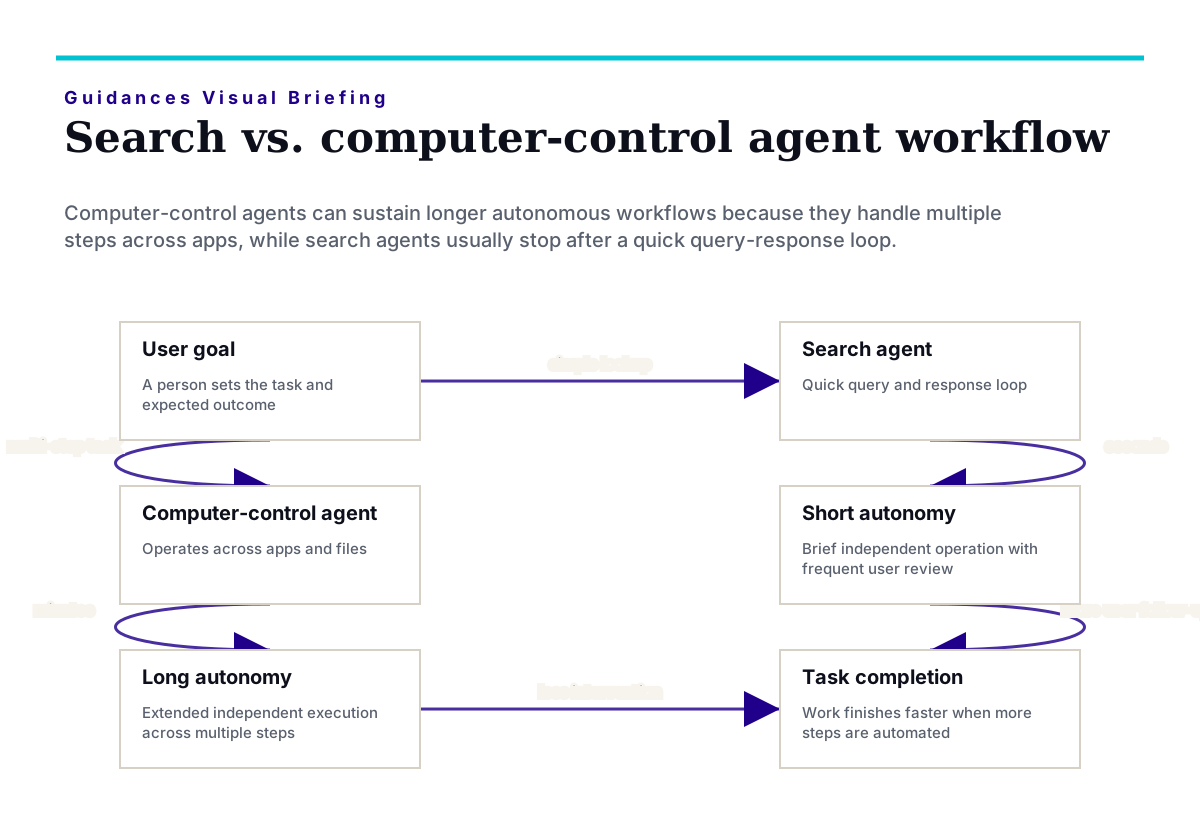
A simple comparison of how search agents and computer-control agents differ in autonomy and workflow depth.
Corrections and safety
See a factual, privacy, rights, or safety issue? Review the corrections process or contact Guidances before relying on this article for important decisions.