Science
Ongoing · 1 updateFact 8/10DeepMind measures AI learning effects in Sierra Leone school trial
Google DeepMind says a randomized controlled trial across 12 schools in Sierra Leone and 1,763 junior secondary students found that guided AI learning lifted mathematics scores by 0.258 standard deviations. The result reinforces a broader shift in edtech: AI tools will increasingly be judged by learning outcomes, not by novelty or usage alone.
Open article · no sign-in required
Sources and disclosure
The core factual claims are supported by the provided context: DeepMind reported a randomized controlled trial in Sierra Leone, involving 12 schools and 1,763 junior secondary students, with guided learning associated with a 0.258 standard deviation gain in math scores over eight weeks. The article also stays appropriately cautious about limits and does not overstate the evidence. Some broader market and policy framing is interpretive rather than directly verified, but it is presented as analysis rather than a factual assertion.
Market lens
Research automation shifts advantage toward faster experiment feedback loops
The signal is whether labs and vendors compete on iteration speed, failed-experiment recovery, and instrument integration rather than one-off model scores.
Impact path
Benchmarks → feedback speed
Signals to watch
- Benchmark adoption by labs and automation vendors
- Robotics and planning tools integrating into one loop
- Claims around cycle time, recovery rate, and dataset quality
Verification schedule
D+1 · Jun 15
Do labs report shorter experiment cycles?
D+3 · Jun 17
Do vendors expose end-to-end planning plus execution?
D+7 · Jun 21
Do benchmarks influence procurement or grants?
Informational context only — not investment, legal, tax, or financial advice.
Google DeepMind says it ran a randomized controlled trial in 12 schools in Sierra Leone involving 1,763 junior secondary students. According to the company, students using guided AI learning improved their mathematics scores by 0.258 standard deviations over eight weeks. DeepMind also reports a shift in student behavior toward conceptual understanding and skill building rather than simple answer-seeking. Taken together, the findings are notable not because they settle the debate over AI in education, but because they move it from general claims toward a measurable outcome in a real school setting.
That distinction matters. Education technology has long been crowded with products that can demonstrate activity but not necessarily learning. Time spent in an app, number of prompts answered, or frequency of use can be useful operational metrics, yet they do not prove that students know more or understand better. A randomized controlled trial is therefore important not as a marketing device, but as a method for separating correlation from effect. In this case, DeepMind is presenting a result that links a specific form of guided AI use to a measurable improvement in mathematics performance.
The result should still be read with restraint. The trial was limited to one country, one age group, one subject, and an eight-week period. Those boundaries matter because educational effects often depend on context: curriculum alignment, teacher involvement, device access, language, and the broader school environment. A gain observed in a controlled setting may not persist over a full academic year, and it may not transfer cleanly to other subjects or education systems. The company’s report therefore offers evidence of possibility, not proof of universal applicability.
Even so, the commercial implications are significant. Buyers of education technology, whether ministries, school networks, or private operators, are likely to become more selective as AI products proliferate. A tool that can show a measurable learning gain in a controlled trial has a stronger case than one that only promises convenience or personalization. This is especially relevant in a market where many AI products are easy to demo but difficult to evaluate. If procurement decisions increasingly depend on evidence, then product teams will need to design for outcomes from the outset rather than retrofit measurement later.
That shift changes what counts as product quality. In education, the most important variable may not be the sophistication of the model alone, but the design of the learning loop around it. Feedback timing, task structure, teacher integration, and the fit between content and curriculum can matter as much as the underlying system. A guided learning experience can succeed where a generic chatbot does not because it constrains the interaction toward instruction rather than open-ended conversation. The DeepMind report, as described in the available metadata, points in that direction: the value appears to come from guided use, not from unrestricted access to a model.
For builders, the operational lesson is that local conditions are not secondary details. Low-resource settings can magnify the importance of language support, connectivity, device availability, and teacher capacity. A product that works in one school context may fail in another if the surrounding infrastructure is different. That is not a weakness of the trial; it is the reality of education deployment. The more ambitious the rollout, the more the product must be adapted to the realities of the classroom. In practice, this means that localization is not merely translation. It includes curriculum mapping, assessment alignment, and a clear role for teachers in the learning process.
The policy implications are equally important. If AI is to be used in schools, public authorities will need to think beyond access and novelty. Data protection, student privacy, evaluation standards, and teacher responsibilities all become part of the procurement question. Education systems are not simply buying software; they are shaping how learning is measured and delivered. A trial such as this one can help establish that AI deserves serious consideration, but it also raises the bar for governance. If a tool affects learning outcomes, then the standards for oversight should be correspondingly high.
There is also a broader strategic point for the AI industry. Much of the public conversation around education AI has focused on general-purpose chat interfaces and broad claims about personalization. The DeepMind trial suggests that the more durable opportunity may lie in narrower, instructionally integrated products that can be tested against specific learning goals. That would favor builders who can work with schools, assessment experts, and local educators, rather than those who rely on a generic consumer product model. In other words, the market may reward evidence and integration more than breadth.
Still, caution is warranted. An eight-week study cannot answer questions about long-term retention, equity effects, teacher workload, or the possibility that gains fade once the intervention ends. Nor can it establish how much of the improvement came from the AI itself versus the surrounding instructional design. Those are not minor caveats; they are the central limits of any early-stage evidence. The most responsible reading of DeepMind’s report is therefore modest. It shows that AI-assisted learning can produce measurable gains under some conditions, and it suggests that the next phase of competition will be about proving where those conditions exist.
Builder Implications
- Education AI products should be built around measurable learning outcomes, not only engagement or usage metrics.
- Local deployment constraints, including language, curriculum, connectivity, and teacher workflow, should be treated as core product requirements.
- Controlled trials can become a commercial advantage when selling into school systems and public-sector buyers.
Want follow-up alerts? Subscribe by email after reading the public article.
Market lens
Research automation shifts advantage toward faster experiment feedback loops
The signal is whether labs and vendors compete on iteration speed, failed-experiment recovery, and instrument integration rather than one-off model scores.
Impact path
Benchmarks → feedback speed
Signals to watch
- Benchmark adoption by labs and automation vendors
- Robotics and planning tools integrating into one loop
- Claims around cycle time, recovery rate, and dataset quality
Verification schedule
D+1 · Jun 15
Do labs report shorter experiment cycles?
D+3 · Jun 17
Do vendors expose end-to-end planning plus execution?
D+7 · Jun 21
Do benchmarks influence procurement or grants?
Informational context only — not investment, legal, tax, or financial advice.
Visual Briefing
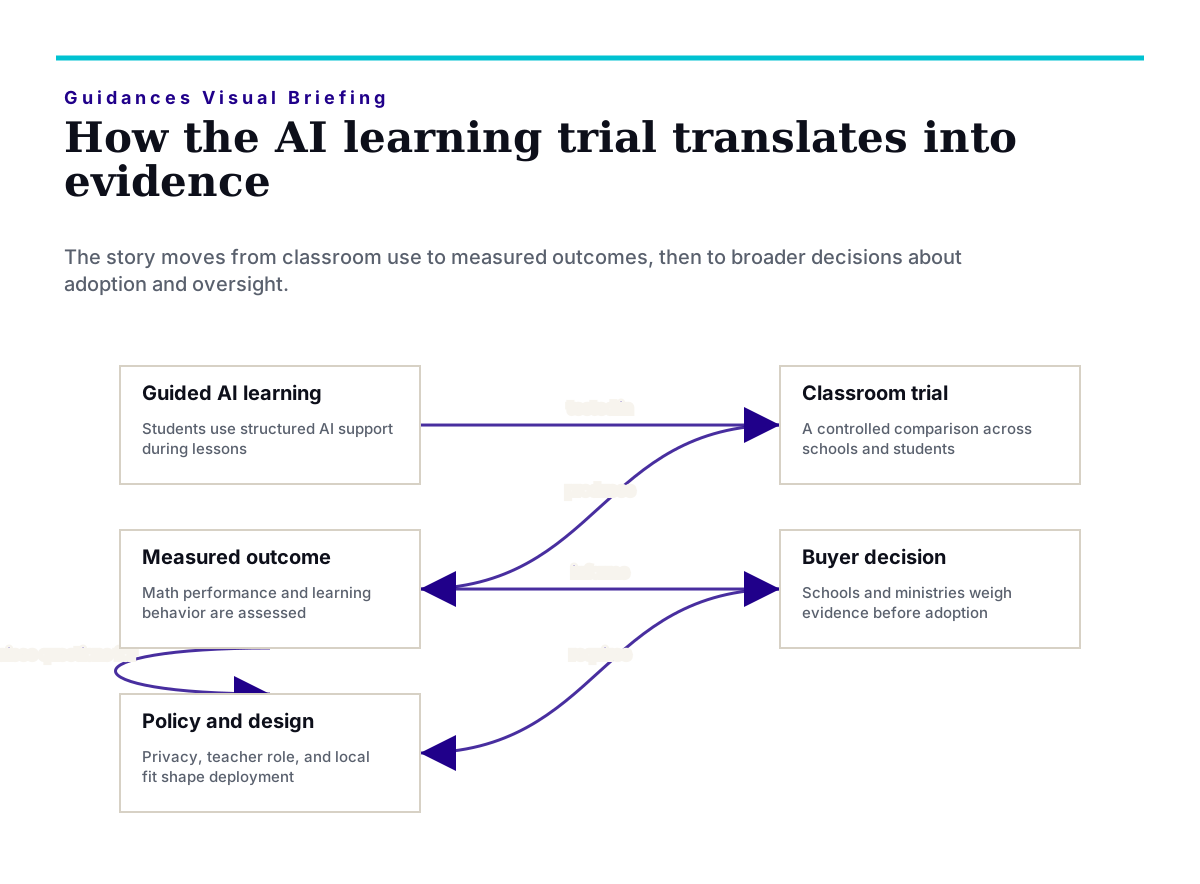
The trial matters because it links guided AI use to measurable learning outcomes, which then shape procurement and policy choices.
Corrections and safety
See a factual, privacy, rights, or safety issue? Review the corrections process or contact Guidances before relying on this article for important decisions.