Science
Developing · 1 updateFact 8/10Expert-Level Academic Question Benchmark Offers New Standard for AI Assessment
Nature has introduced a benchmark of expert-level academic questions designed to assess the scholarly capabilities of AI systems. The benchmark aims to move beyond existing evaluation tools by testing advanced reasoning abilities required in real research environments. The research community anticipates this will enable more accurate measurement of AI models' scientific problem-solving capacity.
Open article · no sign-in required
Sources and disclosure
The core claims regarding Nature's introduction of a new expert-level academic question benchmark for AI assessment are well-supported by the provided context. The context confirms the benchmark's purpose to evaluate advanced reasoning and highlights that current AI models struggle with these questions. Two specific claims, the citation of 'Lab Bench' and a detailed historical overview of AI benchmarks, are not explicitly supported by the provided verification context.
Market lens
Research automation shifts advantage toward faster experiment feedback loops
The signal is whether labs and vendors compete on iteration speed, failed-experiment recovery, and instrument integration rather than one-off model scores.
Impact path
Benchmarks → feedback speed
Signals to watch
- Benchmark adoption by labs and automation vendors
- Robotics and planning tools integrating into one loop
- Claims around cycle time, recovery rate, and dataset quality
Verification schedule
D+1 · Jun 15
Do labs report shorter experiment cycles?
D+3 · Jun 17
Do vendors expose end-to-end planning plus execution?
D+7 · Jun 21
Do benchmarks influence procurement or grants?
Informational context only — not investment, legal, tax, or financial advice.
Nature, a leading journal in academic publishing, has published a new benchmark designed to assess the scholarly capabilities of artificial intelligence systems. The benchmark comprises expert-level academic questions and aims to measure whether AI models possess the complex reasoning and knowledge integration abilities required in real research environments.
Most current AI evaluation tools are designed around general language understanding, common-sense reasoning, or standardized test questions. However, there has been persistent criticism that these benchmarks may not adequately verify the deep domain expertise and composite analytical capabilities required at the frontier of scientific research. Particularly in experimental disciplines such as life sciences, chemistry, and physics, complex thought processes including experimental design, data interpretation, and hypothesis testing are essential beyond simple fact verification.
The research published in Nature was developed to address this gap. The benchmark consists of questions at the level faced by actual academic researchers, evaluating whether AI models can perform understanding and reasoning beyond simply retrieving information or recognizing patterns. This becomes an important criterion for determining whether AI can provide practical value as a research assistance tool.
The research paper cites Lab Bench as a preprint reference. Lab Bench is known to have been designed to evaluate actual scientific problem-solving capabilities in laboratory environments, and appears to have provided important context for the development of the benchmark in this Nature paper. The fact that preprint research results are cited in official papers in major journals suggests that rapid knowledge sharing and collaboration are occurring in the field of AI evaluation methodology.
The emergence of expert-level academic question benchmarks offers several implications for the AI development community. First, it is becoming clear that simple scaling or increasing data volume during model training is insufficient to secure scholarly reasoning capabilities. Instead, domain-specific knowledge, composite reasoning structures, and uncertainty handling capabilities are emerging as important design elements.
Second, the sophistication of evaluation criteria enables more accurate prediction of the practical applicability of AI models. Research institutions, pharmaceutical companies, and biotechnology firms should judge AI tools based on their ability to perform actual research tasks rather than simple benchmark scores when adopting them. This benchmark provides a reference point for such judgments.
Third, discussions about the development direction of academic AI are expected to become more concrete. While current large language models show impressive performance in general question answering and text generation, they still reveal limitations in deep problem-solving in specialized fields. The new benchmark will contribute to clearly revealing these limitations and identifying specific areas requiring improvement.
This announcement also reflects the evolution of AI evaluation methodology itself. Early AI benchmarks focused primarily on multiple-choice questions or simple classification tasks, but recently they have expanded to open-ended questions, composite reasoning, and complex tasks that simulate actual work environments. Expert-level academic questions are a natural extension of this trend and help more accurately define the areas where AI can collaborate with or replace human experts.
Within the academic publishing ecosystem, such benchmarks also hold important significance. As the use of AI tools is being discussed in various areas including peer review, research design review, and data analysis support, reliable evaluation criteria are essential for setting the appropriate scope of use for these tools. The introduction of such a benchmark by an authoritative journal like Nature demonstrates that the academic community is seriously examining the role of AI.
However, some uncertainties exist. The specific composition of the benchmark, the difficulty distribution of questions, and details of the evaluation methodology are difficult to fully grasp from the available information alone. Additionally, further verification is needed to determine how accurately such benchmarks can predict the research contribution capabilities of AI models. There may still be a gap between benchmark performance and usefulness in actual research environments.
In the long term, the development of such evaluation tools will influence the direction of AI research and development. Developers will face pressure to design models capable of contributing to actual academic research, beyond simply achieving high scores on existing benchmarks. This could bring changes to the overall development process, including model architecture, training data selection, and evaluation metric design.
The benchmark's focus on expert-level questions represents a maturation of the field. As AI systems are increasingly deployed in specialized domains, the need for rigorous, domain-appropriate evaluation becomes critical. Generic benchmarks may show high scores but fail to capture the nuanced capabilities required for scientific work. By establishing a standard rooted in actual research challenges, the academic community can better assess which AI systems are ready for deployment in research settings and which require further development.
The citation of Lab Bench as a preprint reference also highlights the evolving nature of scientific communication in the AI era. Preprints allow rapid dissemination of research findings, enabling faster iteration and collaboration. The integration of preprint references into peer-reviewed publications in prestigious journals signals acceptance of this accelerated knowledge-sharing model, particularly in fast-moving fields like AI evaluation.
For organizations considering AI adoption in research contexts, this benchmark provides a framework for due diligence. Rather than relying on vendor claims or general-purpose benchmark scores, research leaders can demand evidence of performance on expert-level academic tasks relevant to their specific domains. This shift toward domain-specific evaluation may drive more targeted AI development and more realistic expectations about AI capabilities.
The benchmark also raises questions about the future of AI in academia. If models can reliably answer expert-level questions, what does this mean for research training, peer review processes, and the division of labor between human researchers and AI assistants? These questions will require ongoing discussion as AI capabilities continue to advance and as evaluation tools become more sophisticated.
Builder Implications
- Expert-level academic benchmarks indicate that AI model development should prioritize domain-specific reasoning capabilities and composite analytical structures. Investment should focus on knowledge integration and uncertainty handling mechanisms rather than simple parameter scaling.
- Teams developing research tools or academic support AI need to integrate such benchmarks into product validation processes to demonstrate usefulness in actual research environments. Customers may prioritize specialized domain evaluation results over general benchmark scores.
- The sophistication of AI evaluation methodology requires changes in how model performance is reported. Developers should provide detailed performance profiles by capability area rather than single scores, and clearly document model strengths and limitations.
Want follow-up alerts? Subscribe by email after reading the public article.
Market lens
Research automation shifts advantage toward faster experiment feedback loops
The signal is whether labs and vendors compete on iteration speed, failed-experiment recovery, and instrument integration rather than one-off model scores.
Impact path
Benchmarks → feedback speed
Signals to watch
- Benchmark adoption by labs and automation vendors
- Robotics and planning tools integrating into one loop
- Claims around cycle time, recovery rate, and dataset quality
Verification schedule
D+1 · Jun 15
Do labs report shorter experiment cycles?
D+3 · Jun 17
Do vendors expose end-to-end planning plus execution?
D+7 · Jun 21
Do benchmarks influence procurement or grants?
Informational context only — not investment, legal, tax, or financial advice.
Visual Briefing
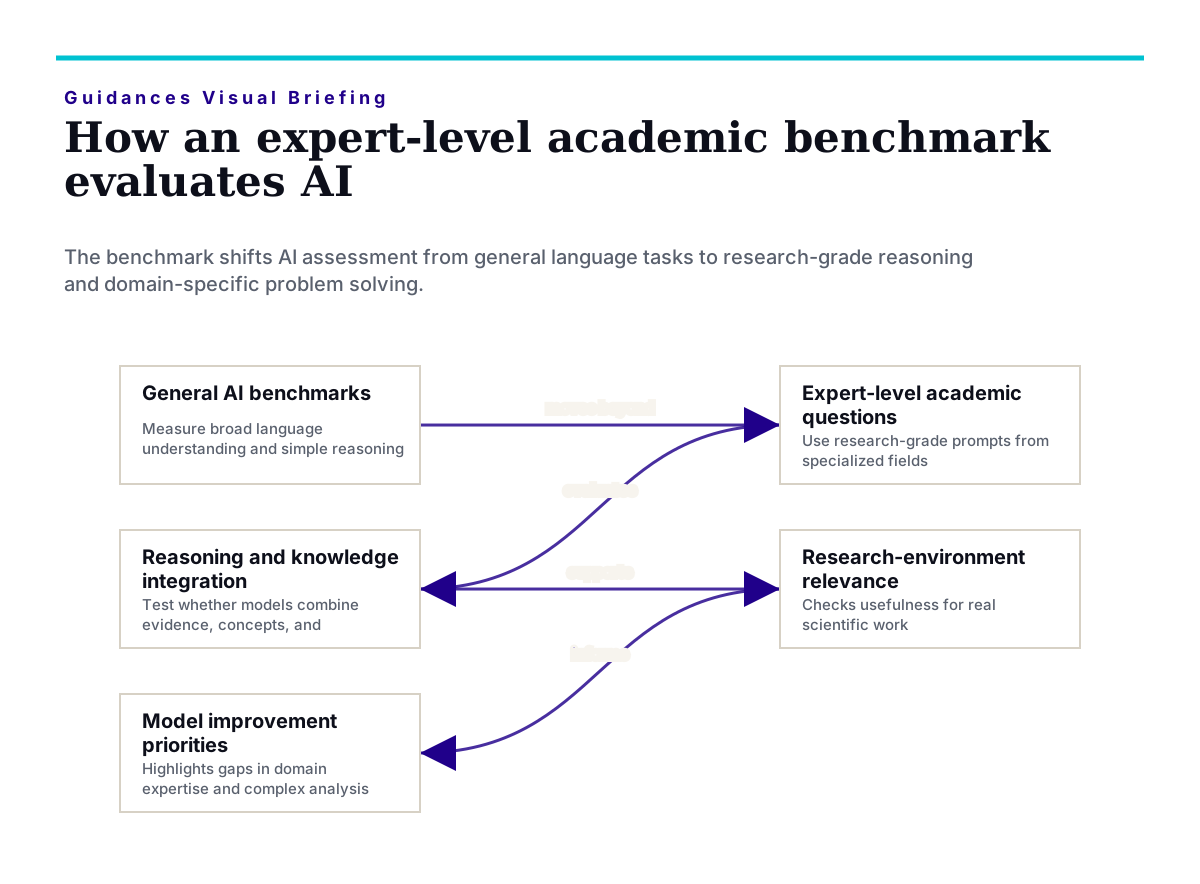
The new benchmark is designed to go beyond standard tests and better reflect the demands of real research settings.
Corrections and safety
See a factual, privacy, rights, or safety issue? Review the corrections process or contact Guidances before relying on this article for important decisions.