Science
Developing · 0 updatesFact 8/10Stanford Advances Real-Time Clinical Validation Studies for Medical Imaging AI Models
Stanford University's Center for Artificial Intelligence in Medicine & Imaging is conducting prospective real-time clinical validation studies of AI models for medical imaging. This is a systematic approach to evaluating the safety and effectiveness of AI tools in actual clinical settings, helping build the evidence base used in regulatory review and healthcare deployment.
Open article · no sign-in required
Sources and disclosure
The central claim is supported by the provided Stanford AIMI source: the center states it is conducting prospective real-time clinical validation studies of AI models for medical imaging. Broader contextual statements about regulatory pathways and industry implications are presented as general background and are not the core factual claim. No reputation-sensitive or accusatory language is present.
Market lens
Research automation shifts advantage toward faster experiment feedback loops
The signal is whether labs and vendors compete on iteration speed, failed-experiment recovery, and instrument integration rather than one-off model scores.
Impact path
Benchmarks → feedback speed
Signals to watch
- Benchmark adoption by labs and automation vendors
- Robotics and planning tools integrating into one loop
- Claims around cycle time, recovery rate, and dataset quality
Verification schedule
D+1 · Jun 15
Do labs report shorter experiment cycles?
D+3 · Jun 17
Do vendors expose end-to-end planning plus execution?
D+7 · Jun 21
Do benchmarks influence procurement or grants?
Informational context only — not investment, legal, tax, or financial advice.
Stanford University's Center for Artificial Intelligence in Medicine & Imaging has announced it is conducting prospective real-time clinical validation studies of AI models developed for medical imaging. This research represents a critical step in evaluating how algorithms developed in controlled laboratory settings perform in actual clinical practice, playing an increasingly important role in the commercialization and regulatory approval processes for medical AI. The initiative underscores a broader industry shift towards more rigorous, evidence-based validation, moving beyond theoretical performance to demonstrated utility in patient care.
Medical imaging AI has advanced rapidly in recent years, with numerous models demonstrating impressive capabilities on historical datasets through retrospective studies. However, the transition from retrospective analysis to real-world clinical deployment presents significant challenges. Actual clinical environments introduce variables distinct from laboratory conditions, including inherent variations in data quality, the vast diversity of patient populations, complexities of workflow integration, and stringent temporal constraints. Retrospective studies, while valuable for initial development, often fall short in predicting performance under these dynamic, uncontrolled conditions. Prospective real-time validation, conversely, is a methodology specifically designed to evaluate the performance, safety, and clinical utility of AI models as they are used in real time during actual patient care, thereby addressing these real-world complexities directly.
Stanford's approach reflects the growing imperative for evidence-based validation within the medical AI field. Regulatory agencies, notably the U.S. Food and Drug Administration (FDA), increasingly mandate robust clinical validation data for AI software classified as medical devices. For high-risk applications that directly assist diagnosis or influence critical treatment decisions, prospective study results carry substantial weight in the approval process. This is because prospective data offers a more reliable indication of a device's performance and safety when interacting with diverse patient populations and varied clinical workflows, which is essential for establishing regulatory confidence and ensuring patient safety.
Medical imaging stands as one of the most active and promising areas for AI application. AI models are being developed across a wide array of modalities, including radiological imaging, pathology slides, ophthalmic imaging, and cardiac ultrasound, with some already progressing into commercialization. Despite this rapid technological advancement, the actual rates of clinical adoption have often lagged. This disparity can be attributed to a confluence of factors, including insufficient real-world validation, the inherent difficulties of seamlessly integrating AI tools into existing clinical workflows, and the critical need to build trust and confidence among clinicians who will ultimately use these technologies.
Prospective clinical validation serves as a pivotal mechanism to bridge this gap between technological potential and practical clinical utility. This methodology involves the systematic deployment of AI models within authentic clinical environments. Here, the models generate predictions in real time on new, unseen patient data. These predictions are then rigorously compared against actual clinical outcomes and the independent judgments of medical professionals. Beyond mere technical accuracy, this process meticulously measures a comprehensive suite of performance metrics, including sensitivity, specificity, positive predictive value, and negative predictive value. Crucially, it also facilitates the identification and evaluation of error patterns, potential biases, and the model's generalization capability across diverse patient cohorts and clinical scenarios.
Stanford's research further emphasizes evaluating the broader clinical impact of AI models. This extends beyond a narrow focus on technical accuracy to ascertain whether AI tools deliver tangible clinical value. Such value can manifest as reduced diagnostic time, enhanced diagnostic accuracy, improved treatment decisions, and ultimately, better patient outcomes. Quantifying these benefits is vital, as they directly influence adoption decisions by healthcare institutions and play a significant role in shaping insurance reimbursement policies, thereby determining the economic viability and widespread acceptance of AI solutions.
For medical AI developers and startups, engaging with such validation studies offers several important implications. First, it is crucial to establish comprehensive clinical validation strategies from the earliest stages of product development. Relying solely on high performance demonstrated on retrospective datasets may prove insufficient for regulatory approval and successful market entry; a clear plan for validation in actual clinical settings is indispensable. Second, building robust collaborative relationships with established healthcare institutions is paramount. Prospective studies necessitate access to hospital infrastructure, active participation from clinical staff, and adherence to stringent ethical approval processes, making partnerships with academic medical centers highly advantageous. Third, a thorough understanding of and preparation for regulatory pathways is essential. Various routes exist, such as FDA 510(k) clearance, De Novo classification, and potentially future Pre-Cert programs, each demanding different levels and types of clinical evidence. Prospective validation data is particularly critical for novel indications or high-risk applications where the safety and efficacy profile must be unequivocally demonstrated. Fourth, ensuring the quality and diversity of data used for both training and validation is critical. Real-world clinical data inherently contains more noise and variability than curated laboratory datasets, underscoring the importance of developing models with robust performance and generalizability.
Validation studies conducted by leading academic institutions like Stanford play a crucial role in establishing benchmarks and best practices for the entire medical AI field. By pioneering exemplary approaches in study design, defining robust evaluation metrics, and setting standards for reporting methods, these institutions contribute significantly to elevating the overall quality of validation across the industry. This, in turn, fosters greater trust and confidence among regulatory agencies and the broader medical community. The cumulative effect extends beyond the validation of individual products, contributing to the overall maturity and responsible evolution of the medical AI ecosystem.
However, prospective clinical validation is a resource-intensive endeavor, demanding considerable time and financial investment. The entire process, from initial study design and ethical approval through patient recruitment, meticulous data collection, rigorous analysis, and eventual publication, can span many months to several years. This lengthy timeline often unfolds against a backdrop of a rapidly evolving AI technology landscape, posing challenges for maintaining model relevance and managing iterative updates. Furthermore, the validation process inherently carries the possibility that a model's limitations or even failures may be revealed, requiring developers to address these findings transparently. Despite these inherent uncertainties and complexities, rigorous clinical validation is becoming firmly established as an indispensable process for the responsible development, safe deployment, and successful integration of medical AI into healthcare.
As the medical AI market continues its trajectory of growth, discussions surrounding advanced validation methodologies are intensifying. Emerging approaches include the validation of continuously learning models, which adapt over time; multi-institutional validation efforts to enhance generalizability; the strategic utilization of real-world evidence (RWE) from routine clinical practice; and the design of adaptive clinical trials that can adjust based on interim results. Stanford's ongoing research not only contributes to these methodological innovations but also plays a vital role in validating their practical feasibility and effectiveness within actual clinical settings, thereby shaping the future of medical AI evaluation.
Builder Implications
- Medical imaging AI product development should strategically incorporate prospective clinical validation strategies from the earliest stages of inception. Partnerships with academic medical centers can be highly beneficial, providing access to clinical expertise, infrastructure, and patient cohorts. Relying solely on retrospective dataset performance may prove insufficient for achieving regulatory approval and successful market entry.
- Model robustness is paramount and should be engineered to account for the inherent variability of real-world clinical data and the constraints of existing clinical workflows. Evaluation metrics must be designed not only to demonstrate technical accuracy but also to rigorously prove tangible clinical value, such as quantifiable reductions in diagnostic time, improvements in diagnostic accuracy, or enhanced clinical outcomes.
- Developers must thoroughly understand the specific clinical evidence requirements for each regulatory pathway (e.g., FDA 510(k), De Novo). Integrating prospective validation data collection plans directly into product roadmaps is crucial to align market launch schedules with the necessary validation timelines, ensuring a streamlined path to commercialization and adoption.
Want follow-up alerts? Subscribe by email after reading the public article.
Market lens
Research automation shifts advantage toward faster experiment feedback loops
The signal is whether labs and vendors compete on iteration speed, failed-experiment recovery, and instrument integration rather than one-off model scores.
Impact path
Benchmarks → feedback speed
Signals to watch
- Benchmark adoption by labs and automation vendors
- Robotics and planning tools integrating into one loop
- Claims around cycle time, recovery rate, and dataset quality
Verification schedule
D+1 · Jun 15
Do labs report shorter experiment cycles?
D+3 · Jun 17
Do vendors expose end-to-end planning plus execution?
D+7 · Jun 21
Do benchmarks influence procurement or grants?
Informational context only — not investment, legal, tax, or financial advice.
Visual Briefing
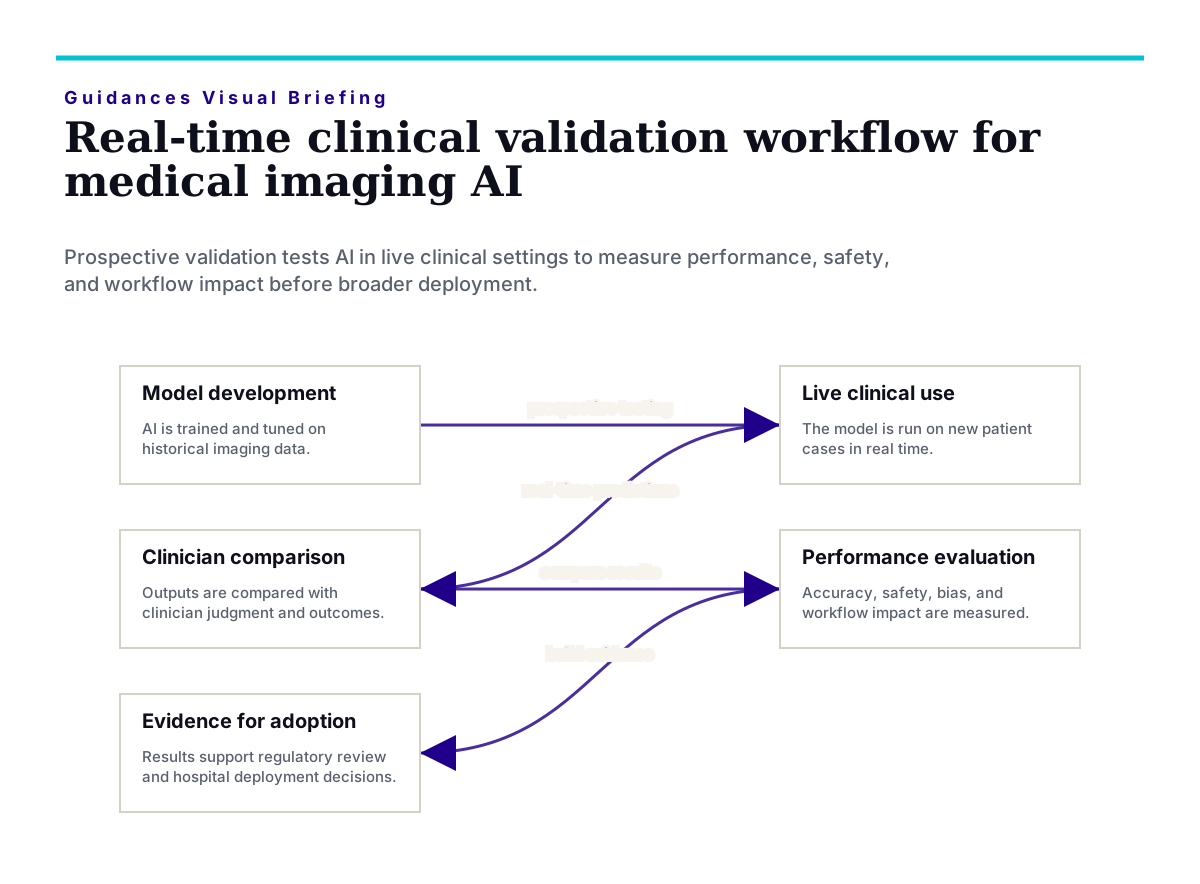
A simplified flow showing how medical imaging AI moves from development into prospective validation and then into evidence for approval or adoption.
Corrections and safety
See a factual, privacy, rights, or safety issue? Review the corrections process or contact Guidances before relying on this article for important decisions.